

Frozen version from . This page never changes.
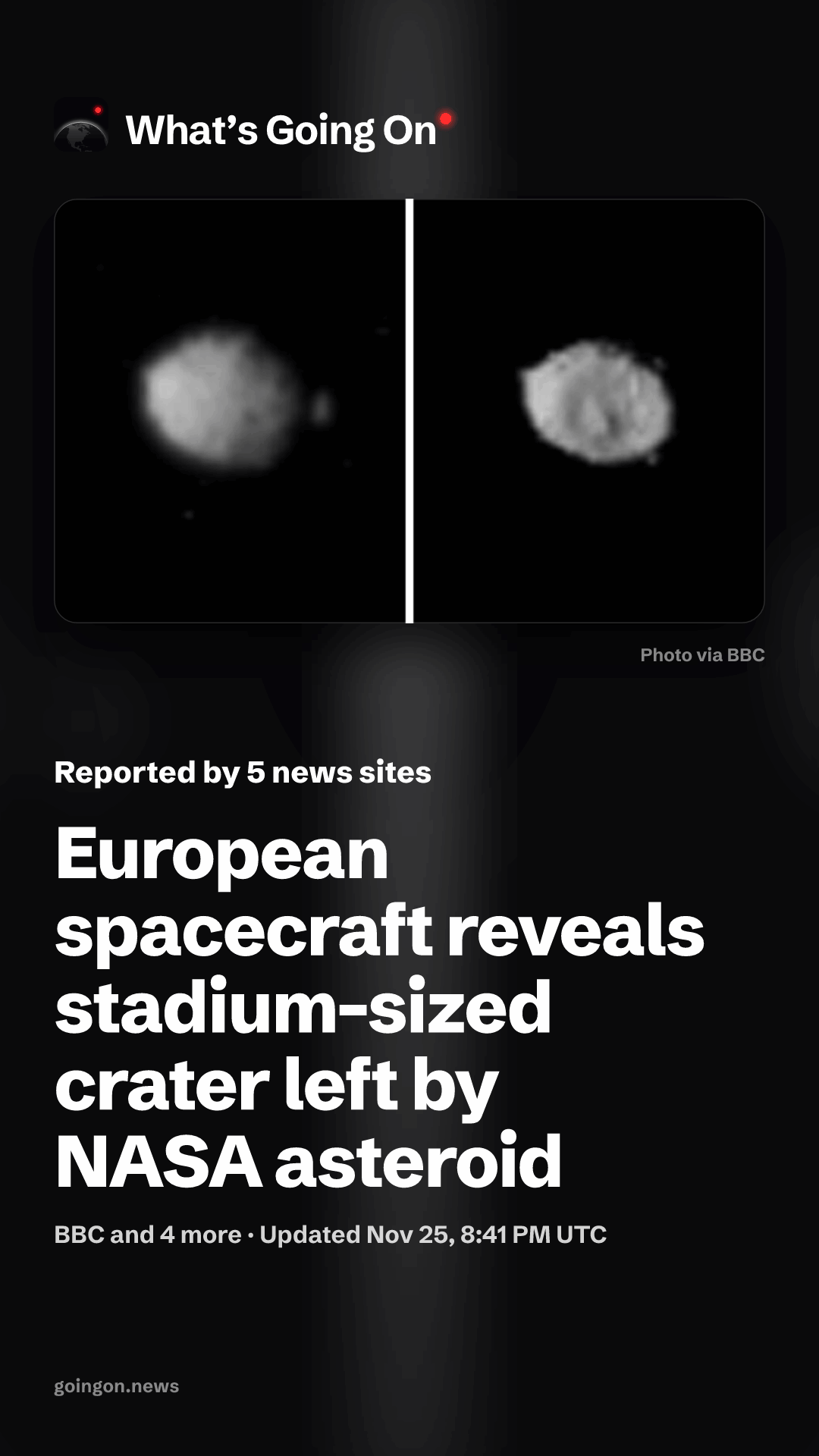
European spacecraft reveals stadium-sized crater left by NASA asteroid
Headline from UPI.
What we know, in the news sites’ own words
A spacecraft observing the asteroid will approach within 13km of it next month, obtaining increasingly higher-resolution images.The asteroid's surface was transformed after a spacecraft was deliberately crashed into it four years ago- 5 news sites
- Updated
More from the reports
The European Space Agency released the first images from its Hera spacecraft, revealing a stadium-sized crater left by a NASA asteroid.Key numbers and quotes
- 13 km
Who reported it, and when
First in our feeds: BBC at .
- Latest report: “New photos reveal stadium-sized crater in asteroid knocked off course by NASA” (ABC Australia, ).
- First report in our feeds: “Four years after huge asteroid crash, a spacecraft has now returned to assess the damage” (BBC).
- So far covered only by US, UK and European news sites.
- BBCFour years after huge asteroid crash, a spacecraft has now returned to assess the damageThe asteroid's surface was transformed after a spacecraft was deliberately crashed into it four years agoHeadline later changed to: Images of asteroid targeted to test Earth's defences reveal stadium-sized crater
- Yahoo TechClose-up images to be revealed of asteroid deliberately hit to test ability to protect Earth
- SpaceHera spacecraft gets 1st up-close look at stadium-sized hole punched in asteroid by NASA DART mission
- CBCRemember when NASA slammed a spacecraft into an asteroid? We now have close-up images of the aftermathFour years after NASA slammed a spacecraft into an asteroid to see if it could successfully alter its orbit around a larger companion, the European Space Agency's Hera spacecraft has arrived to see just how well that went.
- UPIEuropean spacecraft reveals stadium-sized crater left by NASA asteroidThe European Space Agency released the first images from its Hera spacecraft, revealing a stadium-sized crater left by a NASA asteroid.
- ABC AustraliaNew photos reveal stadium-sized crater in asteroid knocked off course by NASAA spacecraft observing the asteroid will approach within 13km of it next month, obtaining increasingly higher-resolution images.
How we counted this
The count is how many separate news sites reported this story. A claim that many news sites repeat is still a claim until it is confirmed independently.
Sentences from the news sites’ own feed summaries; we don't write or edit them.
Only from the reports listed below. What’s Going On does not write its own account of events.
Last checked . Times are when each news site published the story. A check mark beside a time means we read it from the article page itself; other times come from the news site’s feed and can be a later update. “About” marks a site that publishes no exact time; those reports are not counted.
On the list, “First report” is the report credited first. “Earlier, not credited first” is a report from before it that was a preview, had its headline changed, or whose time could not be checked. Reports marked “Not counted” are opinion, side stories, roundups, live blogs or about something else. Some counted reports have since left their news site’s feed; they still count and stay linked.
What’s Going On groups headlines from 71 news sites automatically and links every one of them. Spot a mistake? The full list above shows exactly what we saw.